How Long Does a 4-Inch Air Filter Like 12x30.5x4 Last?
Your filter has been at work since the day you installed it — catching dust, pollen, pet dander, and everything else that travels through your home's air before any of it reaches your family's lungs. The problem is, there's a point where a filter stops protecting and starts restricting. It can't tell you when it gets there. That's on you to know.
The good news: once you know what to look for, this isn't complicated.
Our 12x30.5x4 air filters typically last 3 to 6 months. That's the number — but it's not the whole picture. We've been manufacturing filters for over a decade and shipping them to more than two million homes across the country. The question we hear more than almost any other isn't about sizing or MERV ratings. It's this: how do I know when mine has actually run its course?
Most homeowners are getting this wrong in one of two directions. They swap the filter early out of anxiety — before it needs to go — or they leave it in long past its useful life without realizing what that's costing them in air quality and energy use. Both are fixable. This guide covers everything you need to make the right call for your home, every time
TL;DR Quick Answers
How long does a 4-inch air filter last?
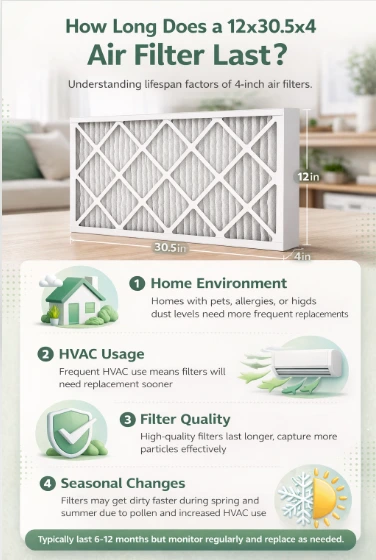
3 to 6 months in a standard home. Shorter with pets, smoke exposure, or a system that runs around the clock.
What is the actual size of a 12x30.5x4 filter?
12.00 x 30.50 x 3.63 inches. The 12x30.5x4 is the nominal size you use to order.
How often should I replace my 12x30.5x4 filter?
Every 3 to 6 months as a baseline. Check visually every month. With pets or wildfire exposure, check every 4 to 6 weeks.
Does a 4-inch filter last longer than a 1-inch filter?
Yes — three to six times longer, depending on conditions. More depth means more surface area, which means more capacity before the filter fills up.
Which MERV rating lasts the longest in a 12x30.5x4 filter?
MERV 8 — up to 6 months in a standard home. It traps fewer fine particles than MERV 11 or 13, so it takes longer to fill.
Can a clogged filter raise my energy bill?
Yes. The U.S. Department of Energy links dirty filters to a 5% to 15% increase in HVAC energy consumption. A fresh filter is one of the cheapest ways to keep monthly utility costs down.
Top Takeaways
A 12x30.5x4 air filter typically lasts 3 to 6 months — three to six times longer than a standard 1-inch pleated filter.
The actual cut dimensions are 12.00 x 30.50 x 3.63 inches. The 12x30.5x4 label is the nominal size used for ordering.
MERV 8 lasts the longest — up to 6 months under standard conditions. MERV 11 runs 2 to 4 months. Check MERV 13 every 6 to 8 weeks.
Every pet in the house knocks roughly 30 days off filter life. Two pets running MERV 11 means checking at 8 weeks, not 4 months.
A clogged filter can push HVAC energy consumption up 5% to 15%, per the U.S. Department of Energy.
Gray buildup, weaker airflow, rising energy bills — these are the signals a filter is past due, regardless of what the calendar says.
A Filterbuy subscription ships your next 12x30.5x4 before you need it. No reminders, no missed cycles, no scrambling for a last-minute replacement.
Why 4-Inch Filters Like the 12x30.5x4 Last Longer
Thickness isn't a selling point. It's physics.
A deeper filter has more surface area — more room to capture and hold airborne particles before the media gets saturated and starts blocking airflow. A standard 1-inch filter runs out of that room fast, which is why the replacement window for that format is 30 to 90 days. A 4-inch pleated filter, like the 12x30.5x4, has the capacity to do the same job over a much longer stretch.
Our filters are built with electrostatically charged synthetic media. Instead of just blocking particles as air passes through, the media actively pulls them in — which means the filter keeps working even as the pleats fill up. Wire backing holds the pleats in shape through the full working life, so you don't get the kind of collapse that turns a cheaper model into an airflow problem before it's had time to do anything useful. The beverage board frame handles heat and humidity without warping. A warped frame lets air bypass the media entirely. That defeats the whole point.
Nominal vs. Actual: What 12x30.5x4 Actually Means
The 12x30.5x4 printed on your filter is the nominal size — the label dimension used to match the filter to your slot. The actual cut dimensions on a Filterbuy 12x30.5x4 are 12.00 x 30.50 x 3.63 inches. We manufacture filters slightly smaller than the nominal label so they slide in cleanly without forcing or bending.
When you measure your current filter or your filter slot, round up each dimension to find the right nominal size to search on our site. If the filter is missing or damaged and you're measuring the slot opening directly, same process.
Get the fit wrong and you're not just getting less protection — you're shortening the filter's effective life. A filter sitting loose lets unconditioned air slip past the media. A filter forced in at an angle does the same thing. Neither is filtering what it should.
How MERV Rating Affects Your 12x30.5x4 Filter's Lifespan
MERV stands for Minimum Efficiency Reporting Value. In plain terms, it tells you how fine a particle the filter can catch. Higher MERV means finer filtration — and a filter that fills faster, because it's trapping more of what's in your air.
MERV 8: Captures 90% of airborne particles. Right choice for a home without pets or serious allergy concerns. Under standard conditions, this filter can run up to 6 months.
MERV 11: Captures 95% of particles — pet dander, mold spores, and fine dust included. The better fit for homes with pets or mild allergies. Expect 2 to 4 months depending on pet load.
MERV 13: Captures 98% of particles, including smoke, bacteria, and fine allergens. Best for households managing respiratory conditions or anyone living through wildfire season. Check it every 6 to 8 weeks.
From what we've seen across millions of households, MERV 11 hits the right balance for most homes. Better protection than the baseline without the faster fill-up that comes with 13.
What Shortens the Life of Your Filter
Not every home runs the same conditions. These are the factors that most consistently cut a 12x30.5x4's lifespan short:
Pets: Every shedding animal in the house knocks roughly 30 days off the filter's life. Two dogs and a cat can turn a 6-month filter into a 3-month one.
Allergy sufferers or respiratory conditions: Run a higher MERV and check the filter every 6 to 8 weeks regardless of filter depth.
Wildfire smoke or high outdoor pollution: Ash and soot load a filter fast. During an active smoke event, check monthly.
Continuous fan mode: Running the fan all day circulates more air — and more particles — through the filter every hour. That adds up.
Large homes or high occupancy: More people, more airborne material per cycle. Larger homes push higher air volumes through the system continuously.
Home construction or renovation: Drywall dust and insulation fibers load a filter faster than a month of normal household use. Change it as soon as the work wraps.
Signs It's Time to Replace Your 12x30.5x4 Filter
The calendar is a useful starting point. But your filter will signal when it's done before the date gets there. Watch for:
A gray or brown face on the filter — a clean one is white or off-white
Weaker airflow from supply vents even when the system is running hard
Energy bills climbing without any change in how you're using the system
More dust landing on surfaces between your regular cleaning
Allergy or asthma symptoms that feel worse inside than outside
A stale or musty smell coming through the vents
If you're seeing more than one of these at the same time, don't wait for the next calendar date. Change it now. Check your filter visually every month and decide based on what you see — not just when you last swapped it.
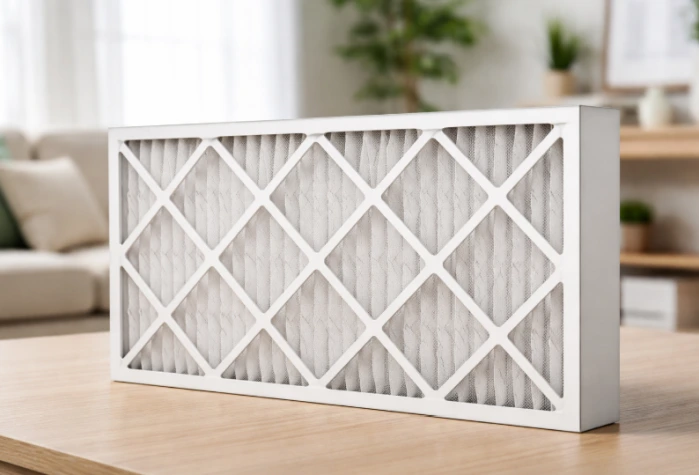
"After manufacturing air filters for over a decade and seeing how more than two million households actually use them, the thing that surprises people most is this: a filter doesn't wear out — it fills up. How fast that happens has almost nothing to do with the calendar and everything to do with what's living and happening inside your home."
7 Essential Resources on Air Filter Maintenance and Indoor Air Quality
Not all sources are created equal. Every link below comes from a U.S. government agency. These are the authoritative resources behind the recommendations in this guide.
1. EPA: Guide to Air Cleaners in the Home
https://www.epa.gov/indoor-air-quality-iaq/guide-air-cleaners-home
The EPA's main consumer guide to HVAC filters and portable air cleaners. Covers filter type selection, MERV rating guidance, and replacement schedules. If you want to understand what your filter is actually doing inside your system, start here.
2. EPA: What Kind of Filter Should I Use in My Home HVAC System?
EPA's specific guidance on MERV ratings for residential use. Explains why MERV 8 is the standard default and what upgrading to MERV 13 delivers — useful if someone in your home has respiratory concerns.
3. EPA: Indoor Air Quality
https://www.epa.gov/air-quality/indoor-air-quality
The EPA's full indoor air quality resource, including the widely cited finding that Americans spend roughly 90% of their time indoors. Puts the stakes of indoor filtration in plain terms.
4. U.S. Department of Energy: Air Conditioner Maintenance
https://www.energy.gov/energysaver/air-conditioner-maintenance
DOE guidance on maintaining residential air conditioning systems. Connects filter maintenance directly to system efficiency and shows how dirty filters drive up operating costs.
5. U.S. Department of Energy: Home Cooling Systems
https://www.energy.gov/energysaver/home-cooling-systems
DOE's energy-saving guidance for residential cooling. Filter maintenance sits front and center — and the link to monthly energy use is laid out clearly.
6. U.S. Department of Energy: HVAC Proper Installation of Filters
https://bsesc.energy.gov/energy-basics/hvac-proper-installation-filters
Building science guidance on HVAC filter installation and upkeep. Explains how dirty filters increase furnace run time, motor wear, and energy draw — making timely replacement a financial issue, not just an air quality one.
7. EPA: Indoor airPLUS Technical Bulletin — Filtration
https://www.epa.gov/sites/default/files/2020-06/documents/2019.11_tech_bulletin_filtration.
EPA's technical filtration bulletin for high-performance residential construction. Defines MERV standards at the particle level and explains the real performance difference between MERV 8, 11, and 13 in terms of what each tier stops.
3 Statistics Worth Knowing
Americans spend roughly 90% of their time indoors.
That means the air running through your filter is the air your family breathes for most of every day. A filter past its useful life isn't a minor annoyance — it's a health variable operating in your home around the clock. Source: U.S. Environmental Protection Agency — Indoor Air Quality https://www.epa.gov/air-quality/indoor-air-quality
Replacing a dirty or clogged filter can cut HVAC energy consumption by 5% to 15%.
The U.S. Department of Energy connects this range directly to filter maintenance. A blocked filter forces your blower motor to work harder to move the same volume of air. That extra effort shows up on your energy bill every month. For most households, a fresh filter pays for itself within the replacement cycle. Source: U.S. Department of Energy — Air Conditioner Maintenance https://www.energy.gov/energysaver/air-conditioner-maintenance
MERV 13 filters capture at least 50% of particles in the 0.3 to 1 micron range — the size class tied to fine allergens, smoke, and certain biological contaminants.
The gap between MERV 8 and MERV 13 isn't just a number on a label. For a household managing respiratory conditions or living through wildfire season, that difference in capture rate is the difference between clean air and compromised air. Source: EPA Indoor airPLUS Technical Bulletin — Filtration https://www.epa.gov/sites/default/files/2020-06/documents/2019.11_tech_bulletin_filtration.pdf
Final Thoughts and Opinion
Here's our honest take.
A 12x30.5x4 filter, matched to the right MERV rating and seated correctly in the cabinet, is one of the most capable tools in a homeowner's maintenance toolkit. In a home without pets, without construction activity, and without outdoor air quality pressure, a MERV 8 version can run for 6 months and do the job right the entire time. We've seen it. We know what these filters are built to handle.
But we'd be doing you a disservice if we stopped there.
Most households have at least one factor that shortens filter life — a dog, a family member with seasonal allergies, a zip code that sees spring pollen or summer wildfire smoke. These aren't edge cases. This is how most American homes actually operate. For most of the families we serve, the 3-month mark is the more reliable benchmark, and a monthly visual check is the habit worth building.
We've watched what happens when homeowners wait too long. A premium 4-inch filter costs a fraction of what an HVAC repair costs. It costs a fraction of what higher energy bills cost when a restricted filter makes a blower motor work harder month after month. And breathing through a saturated, overloaded filter — especially for children and anyone with respiratory sensitivities — is a trade-off not worth making just to squeeze a few more weeks out of something that's already done its job.
Change it on time. Check it monthly. Pick the MERV rating that fits your actual home — not just the one the system shipped with. And if remembering is the hard part, a Filterbuy subscription takes that off your plate entirely.
Frequently Asked Questions
How long does a 12x30.5x4 air filter last?
In a standard home without pets or unusual air quality conditions, a 12x30.5x4 typically runs 3 to 6 months. Homes with pets, allergy sufferers, or heavy HVAC use will see that window shrink to 2 to 3 months. Vacation properties used only occasionally can stretch closer to 6 months or beyond. The most reliable way to know where your home falls? Check the filter visually every month.
What is the actual size of a 12x30.5x4 air filter?
The nominal size — the label you search by — is 12x30.5x4. The actual trimmed dimensions on a Filterbuy 12x30.5x4 are 12.00 x 30.50 x 3.63 inches. We cut filters slightly smaller than the nominal label so they seat cleanly in the cabinet without bending or forcing. When you measure your current filter or your filter slot, round each dimension up to find the correct nominal size.
Which MERV rating should I choose for my 12x30.5x4 filter?
Match the rating to your home, not just your system. MERV 8 is the right call for a home without pets or serious allergy concerns — 90% particle capture, longest lifespan. MERV 11 is the better fit with pets or mild to moderate allergies — 95% capture, including dander and mold spores. MERV 13 is for households managing respiratory conditions or living through smoke season — 98% capture, but check it every 6 to 8 weeks because it fills faster.
Does a 4-inch filter really last longer than a 1-inch filter?
Yes — by a significant margin. A 4-inch filter carries far more surface area than a 1-inch, which means it holds more particulate matter before the media gets saturated. A standard 1-inch pleated filter needs replacing every 30 to 90 days. A 4-inch in the same home at the same MERV rating can run 3 to 6 months. That's not a brand claim — it's what extra surface area does.
Can a dirty 12x30.5x4 filter damage my HVAC system?
It can — and it happens gradually enough that most homeowners don't notice until something breaks. A clogged filter restricts airflow and forces the blower motor to work harder than it was designed to. That extra strain increases energy use, accelerates wear on components, and can freeze the evaporator coil — taking the whole system down. The U.S. Department of Energy puts the energy cost of a dirty filter at 5% to 15% higher consumption. Staying on a replacement schedule is genuinely cheaper than the alternative.
How do I know when my 12x30.5x4 filter needs replacing?
Your filter will show you. A gray or brown face means it's been working hard — a clean filter is white or off-white. Watch also for weaker airflow from supply vents, energy bills climbing without any change in usage, more dust collecting on surfaces between cleanings, allergy symptoms that feel worse inside the house, or a stale smell through the vents. Seeing more than one of these at once? Change it now — not at the next calendar milestone.
Does Filterbuy offer a subscription for 12x30.5x4 filters?
Yes. A Filterbuy auto-delivery subscription ships your next 12x30.5x4 on whatever schedule fits your home. Your fresh filter arrives before your current one is past due — no reminders, no scrambling. Subscriptions include a discount on every delivery. The families who stay on the cleanest air schedules are almost always the ones running a subscription.
How Long Your 12x30.5x4 Filter Lasts Depends on When You Replace It — Make That Easy
Your filter is in stock, ships fast from our American factories, and comes in every MERV rating your home needs. Shop 12x30.5x4 air filters at Filterbuy and set up a subscription so the right filter shows up before the wrong one stays in too long.
Learn more about HVAC Care from one of our HVAC solutions branches…
Filterbuy HVAC Solutions - Miami FL - Air Conditioning Service
1300 S Miami Ave Apt 4806 Miami FL 33130
(305) 306-5027
https://maps.app.goo.gl/Ci1vrL596LhvXKU79